

 English
 Deutsch
 Español
 Français
 Italiano
 Svenska
 Dansk
Dansk Nederlands
 Bokmål
 Suomi
Suomi
Welcome to Tiny Lux — your trusted online destination for premium home appliances that bring luxury, convenience, and...
Read more
Left Banner
New products
New products

Beko CaffeExperto...
£679.00
Regular price
£699.00

Ryobi ONE+ handheld...
£44.10

Silva Schneider MB...
£45.55
Garment steamer vs iron: which do you need?
A garment steamer is useful for quick touch-ups on hanging clothes. An iron is usually the more practical choice for crisp collars, pressed seams and a basket of laundry. If you only want one appliance, choose for the finish you need most often, not simply the quickest advertised heat-up time.
Both use heat, and many irons also use steam, but they work differently in your routine. This guide explains the trade-offs without assuming that every fabric or garment can be treated in the same way.
Steamer or iron: the quick decision
- One or two lightly creased garments before going out: consider a handheld garment steamer.
- Shirts with crisp collars and cuffs, or trousers with a deliberate crease: start with an iron and a suitable board.
- A regular pile of sheets, shirts and everyday laundry: compare irons first; a steam generator may also be worth considering if you have room for its base.
- Limited storage and mainly relaxed clothing: a compact steamer may suit you, provided you have somewhere appropriate to hang garments while working.
For example, someone who wants to tidy a blouse before work has a different task from someone pressing five cotton shirts on a Sunday. Count the garments you actually treat in a normal week before deciding.
Why the finish is different
A conventional iron presses fabric against a supporting surface with a heated soleplate. That makes it useful when you want a defined edge or a smooth, pressed finish. A garment steamer applies steam to relax creases, commonly while the garment hangs. It can be easier to work around gathers and shaped areas without laying the whole garment flat.
Do not expect every handheld steamer to reproduce a pressed finish on heavy, deeply creased fabric. Equally, an iron is not automatically the easiest tool for every garment. Hybrid appliances exist, so check the exact model's supported positions and instructions rather than relying on its category name.
Check the care label before choosing the appliance
Read the garment's care label and the appliance manual together. A delicate fabric is not automatically safe to steam, and “do not iron” should not be treated as permission to use a steamer. Prints, trims, coatings and glued decorations may need different care from the main fabric.
If the instructions permit treatment but you are unsure about the result, test an inconspicuous area first. Keep hot steam away from skin, never steam clothing while someone is wearing it, and use only the support and accessories allowed by the manufacturer. Leave the garment to dry before wearing or putting it away.
Look beyond heat-up time
Tank size and refilling
A compact tank can be convenient for one outfit but may mean refilling during a longer session. A larger tank adds size and, on handheld designs, weight. Compare the intended job with the manufacturer's stated capacity and refill procedure; a bigger number is not automatically more convenient.
Weight, reach and storage
Think about the weight in use, the cable length and where you can safely hang clothes. An upright steamer needs floor space. An iron needs a suitable working surface, while a steam generator also needs space for its separate base. Measure the storage location before buying.
Cleaning and water requirements
Check the specified water type and limescale-care routine. These differ between appliances. Do not add fragrance, vinegar or descaler unless the instructions for that exact model allow it. Maintenance access matters more if you expect to use the appliance several times a week.
Examples to compare at Tiny Lux
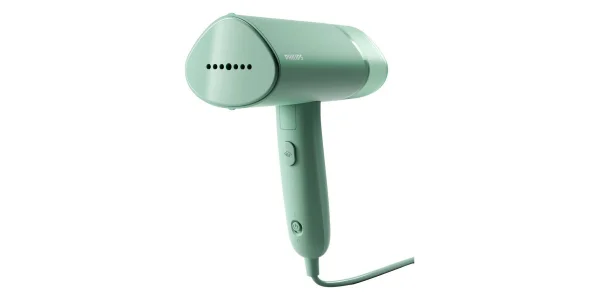
Philips 3000 Series STH3010/70 handheld garment steamer
The Philips 3000 Series STH3010/70 is a handheld-steamer example to compare for occasional touch-ups. For a conventional iron, see the Philips 7000 Series DST7060/20. Check each listing for the exact supplied model, plug and current availability.
Browse garment steamers and steam irons once you have decided which task matters most. These examples illustrate the appliance types; Tiny Lux is not claiming a hands-on comparison or ranking them by performance.
Can a steamer replace an iron?
It may replace one in a household that mainly wants a relaxed finish and occasional crease removal. It is less likely to replace an iron if you regularly press uniforms, structured shirts or trouser creases. If your current iron already does the weekly laundry well, a steamer would be an extra convenience rather than an essential replacement.
Does steaming replace washing?
No. Removing creases is a different job from cleaning a garment. Continue to follow the washing or professional-cleaning instructions on the care label. Do not assume that a general steaming session removes stains or delivers a particular hygiene result.
A practical buying checklist
Write down your three most common garments, the finish you want and where you will use the appliance. Then check care-label compatibility, working space, weight, tank capacity and maintenance. If crisp pressing is central to that list, start with an iron. If the main job is a quick touch-up on a hanging outfit, start with a garment steamer.
Further reading: Tefal's guide to steamer and iron use cases and Philips STH3010/70 support and manuals. Always follow the instructions supplied with your exact appliance.
Posted in:
Blog
Related posts
-
 Welcome to Tiny Lux: Premium Home Appliances with Free Delivery from Germany to the UK, EU, and US
 -
 The Philips Series 3300 LatteGo: Your Perfect Home Barista – Free Delivery from Germany to UK, EU, and USIf you're ready to ditch expensive café visits and enjoy barista-quality coffee at home, the Philips Series 3300...Read more
 -
 Top Premium Coffee Machines to Transform Your Home in 2026: TinyLux's Expert GuideHello coffee enthusiasts! If you're looking to recreate a professional café experience right in your kitchen, you've...Read more
 -
 Ultimate Guide to Premium Air Fryers in 2026: Healthier Cooking with TinyLux's Top PicksHello kitchen enthusiasts and health-conscious home cooks! As we settle into 2026, air fryers continue to dominate...Read more
 -
 Elevate Your Home Coffee Game with the Philips Café Aromis 8000 Series LatteGo Pro EP8757/20 Silver Espresso MachineLooking to buy? The Philips Café Aromis 8000 Series EP8757/20 is in stock at Tiny Lux with full specs, FAQs and...Read more