

 English
 Deutsch
 Español
 Français
 Italiano
 Svenska
 Dansk
Dansk Nederlands
 Bokmål
 Suomi
Suomi
Welcome to Tiny Lux — your trusted online destination for premium home appliances that bring luxury, convenience, and...
Read more
Left Banner
New products
New products

Beko CaffeExperto...
£679.00
Regular price
£699.00

Ryobi ONE+ handheld...
£44.10

Silva Schneider MB...
£45.55
Burr vs blade coffee grinders: which should you choose?
Choose a burr grinder if you want repeatable grind settings and more control over your coffee. A blade grinder can suit occasional brewing on a small budget, but it gives you less control over the size of the grounds. The important next question is what you brew: a grinder that works for a cafetière is not automatically suitable for an espresso machine.
This guide helps you choose by brewing method, daily routine and cleaning effort. It is a buying guide, not a hands-on product test.
What is the difference between burr and blade grinders?
A blade grinder chops beans with a rotating blade. Running it for longer makes the overall mixture finer, but some pieces are repeatedly chopped while others remain larger. You control grinding time rather than a precise particle size.
A burr grinder passes beans between two grinding surfaces. Changing the gap changes the grind setting. This generally produces a more consistent result and lets you return to a setting you used before. Burr grinders still produce a spread of particle sizes; buying one does not remove the need to adjust your recipe.
For a practical comparison, imagine making the same filter coffee three mornings running. With a burr grinder, you can keep the setting fixed and change just the amount of coffee or water. With a blade grinder, you also need to repeat the bean quantity and grinding time, and the result may still vary.
Start with your brewing method
Cafetière and filter coffee
For a cafetière, look for a grinder with a usable coarse range. For a filter machine or pour-over brewer, look for controllable adjustment around the manufacturer's recommended starting point. A burr grinder is useful when you want to make small, repeatable changes rather than simply grind for a little longer.
A blade grinder remains an option if you make coffee occasionally and accept a less consistent result. Keep the dose and technique consistent, follow the grinder's operating limits and judge the coffee you actually drink. Do not buy an expensive grinder solely because somebody else's recipe uses one.
Moka pot
Choose a grinder that can produce grounds appropriate for your particular moka pot, following the pot manufacturer's instructions. Do not assume that an espresso setting is interchangeable with a moka setting. If you are also choosing a pot, our Bialetti moka pot guide covers the different pot types.
Espresso
Check espresso suitability explicitly. A grinder may have a setting labelled “fine” yet lack the adjustment range or small steps needed for your machine and basket. Ask whether it is intended for your type of espresso setup, particularly when using a non-pressurised basket. The number of settings alone does not answer that question.
If you own a bean-to-cup machine with an integrated grinder, you may not need a separate grinder at all. Check the machine's instructions before buying another appliance.
Five checks that matter more than the headline specifications
- Adjustment where you need it. A wide range is useful only if it includes your brewing method. Look for clear instructions and repeatable controls.
- Your usual dose. Consider whether you grind for one mug or a full pot. A large hopper is not a requirement for a small daily batch.
- The whole footprint. Measure clearance for opening the lid and removing the grounds container, not just the base of the appliance.
- Cleaning access. Check which parts are removable, which must stay dry and whether the manual explains how to clear retained grounds.
- Everyday handling. Think about transferring grounds into your brewer, storing the cord and reaching the controls. Motor wattage alone is not a measure of grind quality.
Examples to explore at Tiny Lux
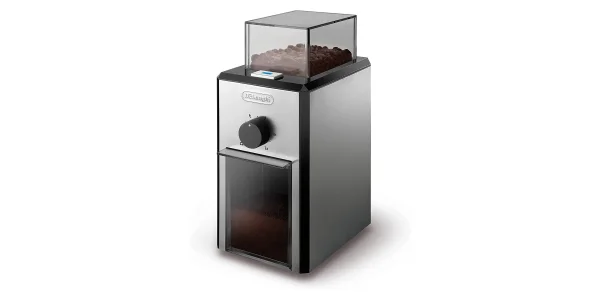
De’Longhi KG89 burr coffee grinder with grounds container
The De'Longhi KG89 is a burr-grinder example. Use its product page and the manufacturer's instructions to check whether its adjustment range suits your brewer; this is not a claim that it is suitable for every espresso basket.
For a blade-grinder comparison, see the Krups F20342. Compare the actual grinding method and controls rather than judging the two appliances by wattage or appearance. You can also browse the coffee grinders category. Check current availability, supplied plug and model details on the individual listing.
How to make a useful first adjustment
Start from your brewer's recommended recipe and the grinder manual's suggested range. Keep the beans, coffee dose and water quantity unchanged for the next brew, then change only the grind setting. Make a note of the result. If you change the beans, dose and grind at the same time, you will not know which change helped.
Follow the manual when adjusting the burrs: some mechanisms require the grinder to be running for certain adjustments. Unplug before cleaning and use only the cleaning method specified for your model. Do not put spices, water or cleaning materials through a coffee grinder unless its manufacturer explicitly permits them.
Which should you choose?
For regular filter coffee or cafetière brewing, start by comparing burr grinders that cover your method. For occasional use with a tight budget, a blade grinder can be a reasonable compromise. For espresso, narrow the shortlist to grinders explicitly suitable for your machine and basket before comparing convenience features.
The most useful upgrade is one that solves a problem in your current routine: inconsistent grounds, awkward adjustment or difficult cleaning. Choose for that problem, not for the largest hopper or the longest specification list.
Technical references: De'Longhi's explanation of grinder types and the instructions for your exact grinder and brewer. Product links are examples, not ranked test results.
Posted in:
Blog
Related posts
-
 Welcome to Tiny Lux: Premium Home Appliances with Free Delivery from Germany to the UK, EU, and US
 -
 The Philips Series 3300 LatteGo: Your Perfect Home Barista – Free Delivery from Germany to UK, EU, and USIf you're ready to ditch expensive café visits and enjoy barista-quality coffee at home, the Philips Series 3300...Read more
 -
 Top Premium Coffee Machines to Transform Your Home in 2026: TinyLux's Expert GuideHello coffee enthusiasts! If you're looking to recreate a professional café experience right in your kitchen, you've...Read more
 -
 Ultimate Guide to Premium Air Fryers in 2026: Healthier Cooking with TinyLux's Top PicksHello kitchen enthusiasts and health-conscious home cooks! As we settle into 2026, air fryers continue to dominate...Read more
 -
 Elevate Your Home Coffee Game with the Philips Café Aromis 8000 Series LatteGo Pro EP8757/20 Silver Espresso MachineLooking to buy? The Philips Café Aromis 8000 Series EP8757/20 is in stock at Tiny Lux with full specs, FAQs and...Read more